
Table of Contents
- The Science Behind Portland’s Pavement-Destroying Weather
- The Engineering Science of Sealcoating—More Than Just a Black Coat
- The Narrow Window: Why Late Summer is Your Last Chance for Sealcoating
- The $1 to $10 Rule: Why Prevention Always Beats Repair
- Industry Research: How Sealcoating Extends Pavement Life by 300%
- Final Thoughts
Picture this: It’s mid-October in Portland. The first significant rainstorm of the season has just passed through, and you walk out to your parking lot or driveway to discover something alarming—fresh cracks have widened into fissures, small depressions have become water-filled potholes, and what looked like minor surface wear just months ago now threatens to become a major structural problem. Worse yet, you realize this damage could have been prevented with a simple, affordable treatment applied just weeks earlier. This scenario plays out across Portland every fall, costing property owners thousands of dollars in emergency repairs that could have been avoided. Portland receives an average of 36.9 inches of precipitation annually, with the overwhelming majority falling between October and April. This prolonged exposure to moisture creates one of the most hostile environments for asphalt pavement in the country. Here’s the financial reality that should grab every property owner’s attention: According to the Federal Highway Administration, for every $1.00 spent on preventive pavement preservation—like sealcoating—property owners save between $6.00 and $10.00 in future reconstruction costs. That’s not marketing hype; that’s engineering economics backed by decades of infrastructure research. This comprehensive guide explains the scientific mechanics of water-induced asphalt failure, why Portland’s unique climate accelerates this degradation, and why property owners must act in late summer or early fall—before temperatures drop and the rainy season begins. As Portland’s trusted asphalt maintenance specialists, Smooth Rollin provides this resource to help you make informed, cost-effective decisions about protecting your pavement investment.
The Science Behind Portland’s Pavement-Destroying Weather
Portland’s climate presents a perfect storm for asphalt degradation. Unlike many regions that face a single dominant threat to pavement, Portland’s Mediterranean climate pattern subjects asphalt to a devastating one-two punch: warm, dry summers followed by cool, excessively wet winters. During the summer months, intense UV radiation begins the destruction process. Ultraviolet rays penetrate the asphalt surface and break down the asphalt binder—the petroleum-based “glue” that holds the aggregate stones together. This oxidation process makes the pavement brittle and inflexible, causing microscopic cracks to form across the surface. While these micro-cracks may be barely visible to the naked eye, they create pathways for water infiltration. Then comes Portland’s notorious rainy season. When October arrives with its average 36.9 inches of annual precipitation concentrated over the next several months, those summer-formed cracks become highways for water penetration. This is where the real destruction begins.
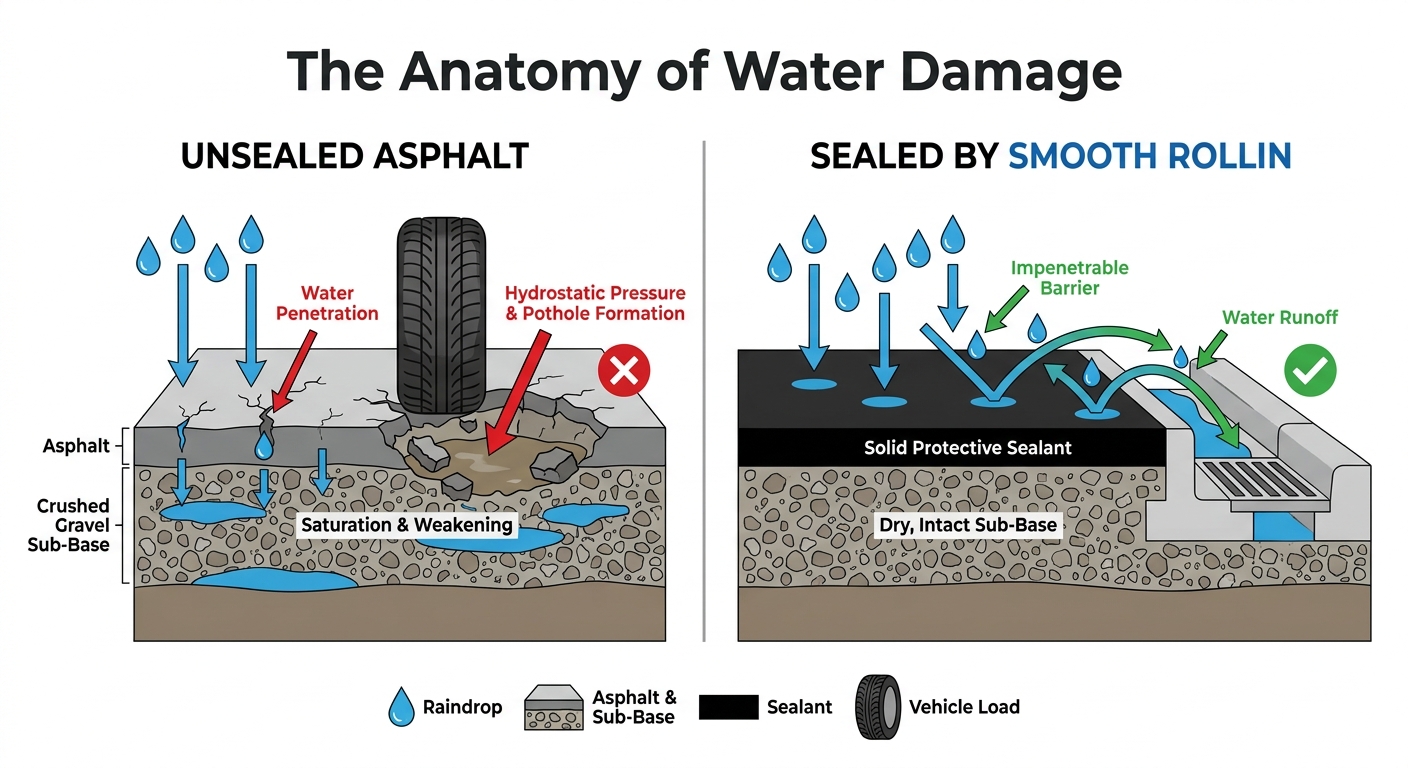
The degradation follows a predictable four-stage process: Stage 1: Summer Oxidation – UV exposure causes chemical breakdown of the asphalt binder, creating surface brittleness and micro-cracking. Stage 2: Autumn Infiltration – October rains penetrate these micro-cracks, seeping through the porous asphalt surface. Stage 3: Sub-Base Erosion – Water reaches the porous aggregate base layer beneath the asphalt. Every time a vehicle drives over the saturated area, the tire creates intense hydrostatic pressure—literally squeezing water deeper into the foundation and washing away the structural support materials. Stage 4: Structural Failure – Even without the freeze-thaw cycles common in colder climates, the combination of moisture infiltration and constant traffic loads leads to “alligator cracking” (interconnected cracks resembling alligator skin) and eventually full pothole formation.
Key Insight: The Asphalt Institute’s research reveals a sobering timeline: “Asphalt pavement naturally degrades by 40% in its first 75% of life, but rapidly degrades by another 40% in the following 12% of its life if left unprotected from moisture.” This means that once water-induced degradation reaches a critical threshold, your pavement deteriorates exponentially faster—turning years of remaining lifespan into months.
For Portland property owners, this isn’t theoretical. The extended wet season from October through April provides continuous moisture exposure that accelerates every stage of this failure process. What might take years to develop in drier climates can happen in a single Portland winter season.
The Engineering Science of Sealcoating—More Than Just a Black Coat
Many property owners mistakenly believe sealcoating is purely cosmetic—a way to make faded asphalt look fresh and black again. While the aesthetic improvement is certainly a benefit, this misconception obscures the primary engineering function of sealcoating: creating a waterproof barrier that prevents the destructive infiltration process described above. Sealcoating is a specialized emulsion—not paint—carefully formulated to bond with asphalt surfaces and seal the porous material. Think of it as preventive maintenance rather than repair, analogous to painting a house to prevent wood rot or applying rust protection to a vehicle’s undercarriage. The sealcoat emulsion provides three critical protective properties:
Waterproofing
This is the primary defensive function. Quality sealcoat fills surface voids and micro-cracks, reducing the pavement’s permeability to nearly zero. When properly applied, water cannot penetrate the surface but instead runs off into drainage systems—exactly as the pavement was originally designed to function. This single property prevents the entire four-stage degradation process that destroys Portland pavements every winter.
Chemical Resistance
Asphalt is a petroleum-based product, which creates a counterintuitive vulnerability: other petroleum products like motor oil, gasoline, and transmission fluid will actually dissolve asphalt on contact. For parking lots and driveways, this means every small leak or drip slowly eats away at the surface. Sealcoat creates an impermeable chemical barrier that prevents these automotive fluids from reaching and damaging the asphalt binder.
Friction Restoration and Surface Protection
Weathering gradually strips away the fine aggregates from the asphalt surface, reducing traction and creating a smoother, potentially more hazardous surface. Sealcoating replaces these lost materials, restoring surface friction for vehicle and pedestrian safety while delivering that rich, jet-black appearance that enhances property curb appeal. The lifecycle extension sealcoating provides is remarkable. Properly timed and maintained sealcoating can extend pavement lifespan from 7-12 years (unsealed) to 20-30+ years (sealed), according to Federal Highway Administration pavement preservation guidelines. This isn’t speculation—it’s based on longitudinal studies tracking pavement performance over decades. Let’s put this in financial perspective with real numbers:
| Pavement Condition | Action Taken | Expected Lifespan | Estimated Lifecycle Cost Impact |
|---|---|---|---|
| Unsealed / Ignored | None | 7-12 Years | Highest (Early full-depth reconstruction) |
| Minor Cracking | Reactive Patching | 12-15 Years | High (Constant pothole repair spending) |
| Properly Maintained | Sealcoating every 3-5 years | 20-30+ Years | Lowest ($1 spent saves $6-$10) |
The message is clear: sealcoating isn’t an optional cosmetic upgrade for Portland property owners. Given the region’s high-moisture climate, it’s a structural necessity that determines whether your pavement investment lasts a decade or three decades.
The Narrow Window: Why Late Summer is Your Last Chance for Sealcoating
Understanding the science of sealcoating leads directly to understanding why timing is absolutely critical—and why Portland property owners have a narrow window of opportunity each year. Sealcoat isn’t like paint that simply dries. It must chemically cure through a complex emulsion-breaking process where water evaporates and the binding agents cross-link with the asphalt surface. This chemical curing requires specific environmental conditions:
- Minimum ambient temperature of 50°F for the duration of application and initial curing
- 24-48 hours of dry weather with no rain or heavy dew
- Moderate humidity to prevent too-rapid surface drying before proper penetration
Interrupt this curing process with cold temperatures or moisture, and you’ll end up with a sealcoat that hasn’t properly bonded to the asphalt surface. The result? Premature failure, peeling, and wasted investment—essentially throwing money away while leaving your pavement unprotected.
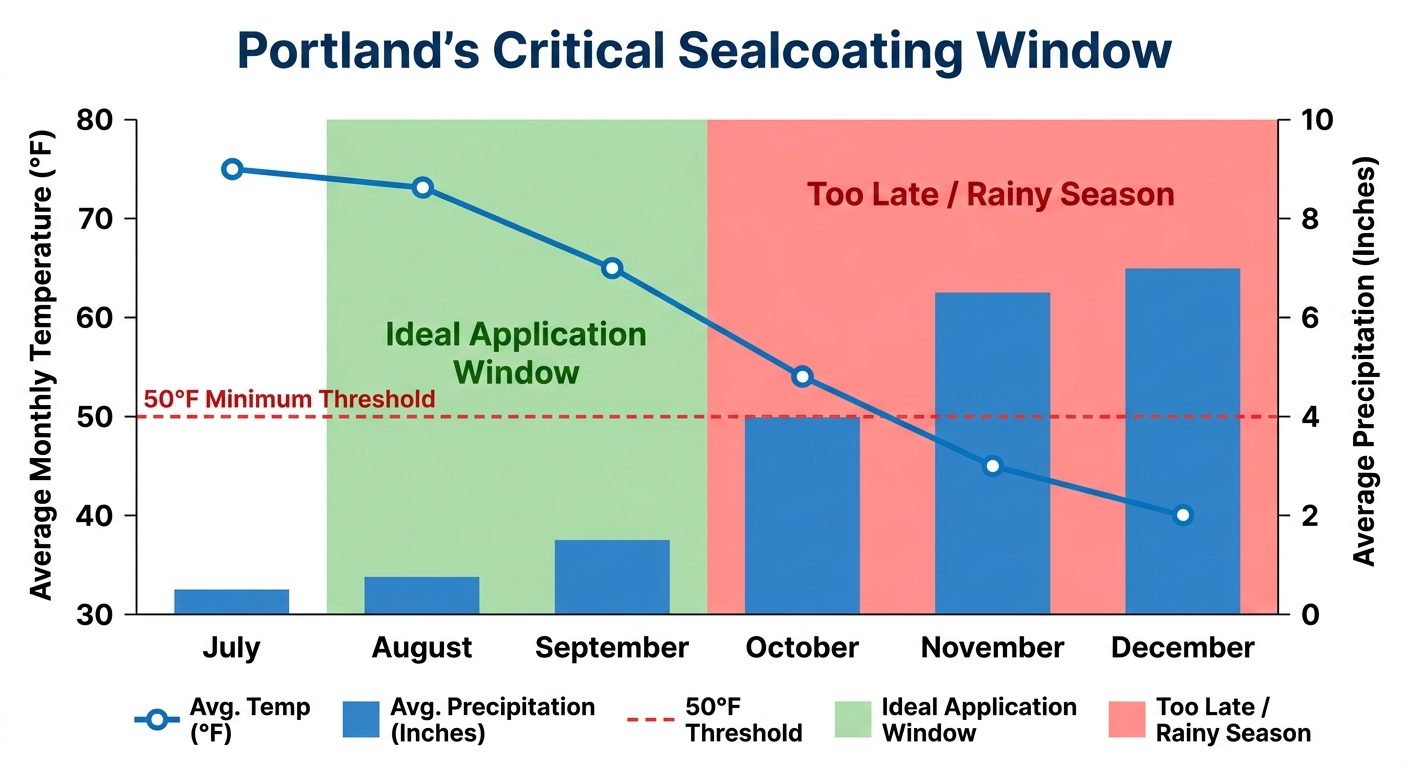
Now consider Portland’s seasonal weather timeline:
August through September represents the ideal application window. Temperatures remain consistently above 50°F, rainfall is minimal, and extended dry periods allow proper curing. These months provide the reliable conditions sealcoating requires to achieve maximum effectiveness and longevity.
October onward brings Portland’s weather transformation. Average temperatures drop toward and below the 50°F threshold, rainfall becomes frequent and consistent, and finding a 48-hour dry window becomes increasingly difficult. Attempting to sealcoat during this period is a gamble with poor odds—risking application failure and leaving your pavement vulnerable through the entire winter season.
Here’s the “too late” scenario that plays out every year: A property owner notices their pavement looking worn and cracked in late October or November. They contact an asphalt company hoping to protect their investment before winter. But by this time, the window has closed. They face two equally unappealing options:
- Accept six months of continued water damage and degradation through winter, then address it in spring (by which time significantly more expensive repairs may be needed)
- Attempt a late-season application in marginal conditions and risk application failure
Property owners who understand this timing reality act proactively in August or early September, securing their sealcoating appointment before the seasonal rush and while conditions guarantee success.
The $1 to $10 Rule: Why Prevention Always Beats Repair
The financial case for pre-winter sealcoating becomes crystal clear when you understand the exponential cost escalation of pavement failure. The National Center for Pavement Preservation champions a “Right Treatment, Right Road, Right Time” philosophy, demonstrating through extensive research that early intervention prevents the rapid degradation phase that leads to astronomical repair costs. Consider how maintenance costs escalate across a typical 10-year pavement lifecycle:
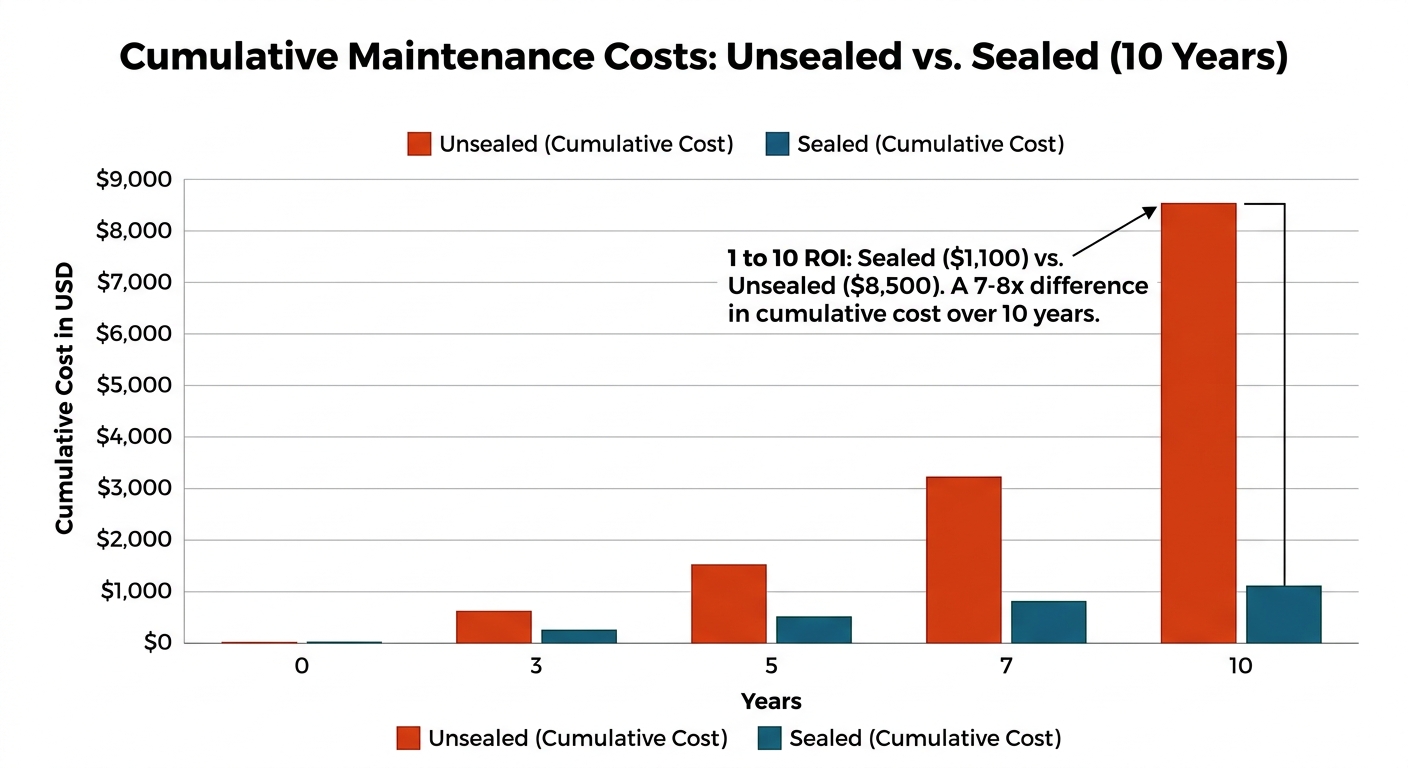
Let’s break down the real-world costs for a typical residential driveway (600 square feet):
Proactive Preservation (Sealcoating)
Costs pennies per square foot. A professional sealcoating service for this driveway runs $150-$300 every 3-4 years. Over 10 years, total investment: approximately $500-$700.
Reactive Repair (Patching and Crack Filling)
Once water damage creates potholes and extensive cracking, repair costs jump to dollars per square foot. Patching potholes, filling cracks, and addressing drainage issues for the same 600-square-foot driveway typically costs $500-$1,500 per major repair event. For neglected pavement, these repairs become necessary every 2-3 years. Over 10 years: $2,000-$6,000.
Full Reconstruction (Sub-Base Failure)
When water completely compromises the aggregate base, the entire pavement structure must be excavated and replaced. Full-depth reconstruction costs $8-$15 per square foot. For our 600-square-foot driveway: $4,800-$9,000 for complete replacement.
Critical Takeaway: The Federal Highway Administration’s research confirms what these numbers demonstrate: for every $1.00 spent on pavement preservation, property owners save $6.00 to $10.00 in future rehabilitation costs. This isn’t a best-case scenario or optimistic projection—it’s the median outcome across thousands of pavement projects nationwide.
This exponential return compounds over time. A $200 sealcoat investment today prevents a $2,000+ repair bill in 2-3 years, which in turn prevents a $5,000+ resurfacing bill in 5-7 years, which ultimately prevents a $10,000+ reconstruction bill in 10-12 years. For commercial properties—parking lots, HOA roads, and business access drives—the stakes are even higher. Beyond the direct cost escalation, reactive repairs create operational disruptions, safety liability risks, and negative customer impressions. Commercial property managers who implement proactive sealcoating as part of an annual maintenance schedule eliminate surprise capital expenses and extend their pavement replacement planning timelines by decades. Think of pavement maintenance like medical care. Annual checkups and preventive measures (sealcoating) cost little and catch problems early. Emergency surgery (full reconstruction) costs exponentially more and could have been avoided entirely with proper prevention. The economic logic is inescapable: Property owners will pay for pavement maintenance. The only question is whether they’ll pay a little now or a lot later.
Industry Research: How Sealcoating Extends Pavement Life by 300%
While the cost comparisons above make a compelling financial argument, the most powerful evidence for pre-winter sealcoating comes from long-term empirical research conducted by the Asphalt Institute and various state transportation departments. One particularly revealing multi-year study tracked commercial parking surfaces to evaluate pavement degradation curves with and without surface treatments. The research team monitored identical pavement installations under similar traffic loads, with the only variable being whether protective sealcoat treatments were applied.
Research Findings
Asphalt pavement degrades relatively slowly through approximately 75% of its service life, losing about 40% of its structural integrity during this extended period. However, if the pavement remains unprotected from moisture during this time, it enters a rapid degradation phase where it loses another 40% of its remaining structural integrity in just 12% of its remaining lifespan.
In practical terms, this means unsealed pavement spends years in slow decline, then suddenly—often after just one or two harsh winter seasons—accelerates into catastrophic failure. The pavement that seemed “fine, just a little worn” in October can develop major structural problems by April. The study’s most important finding: Applying surface treatments like sealcoat before the rapid degradation phase extends the pavement’s overall service life by up to 300%. This isn’t about making old pavement last a few more months—it’s about transforming a 10-year pavement into a 30-year pavement through timely intervention. For Portland property owners, this research perfectly maps to local climate conditions. Portland’s dry oxidation summers create the initial degradation (the slow 75% phase), while the wet infiltration winters trigger the rapid collapse phase (the fast 12% phase). Sealcoating applied in late summer creates a protective barrier that prevents the transition from slow degradation to rapid collapse.
Real-World Scenario Comparison
Consider these scenarios that play out regularly in Portland: Scenario A: A 20-unit apartment complex neglects sealcoating for 8 years, believing their parking lot “still looks okay.” After the exceptionally wet 2023-2024 winter season, they discover extensive alligator cracking, multiple potholes, and drainage failure. Emergency repairs and partial resurfacing: $45,000. Scenario B: A neighboring 20-unit complex implements sealcoating every 3-4 years as preventive maintenance. Over the same 8-year period, they spend approximately $8,000 total on sealcoating. Their parking lot remains structurally sound with no emergency repairs needed, and they’ve extended their full replacement timeline by an estimated 15-20 years. The National Center for Pavement Preservation summarizes the research bluntly: “The economics are clear—every year of delay in preventive maintenance exponentially increases future costs.” For Portland property owners facing one of the nation’s longest and wettest winter seasons, this research isn’t academic theory—it’s a roadmap for avoiding financial disaster.
Final Thoughts
Portland’s climate creates a uniquely challenging environment for asphalt pavement. The combination of UV-intense dry summers followed by prolonged wet winters subjects pavement to a devastating two-stage degradation process that accelerates structural failure. For property owners, this climate reality transforms sealcoating from an optional aesthetic upgrade into an engineering necessity. The financial logic is straightforward and backed by federal infrastructure research: $1 spent on preventive sealcoating saves $6-$10 in future repairs. Property owners who implement proactive maintenance avoid disruptive, expensive emergency repairs while extending their pavement lifespan by decades. But here’s the critical constraint every Portland property owner must understand: Once October’s rains begin and temperatures drop, it’s too late to apply a high-quality sealcoat until spring. That means waiting through 6+ months of additional water damage, accelerated degradation, and mounting repair costs. The late summer window of August through early September isn’t a marketing convenience—it’s a chemical and climatological requirement. Property owners who act proactively during this window protect their investment during Portland’s most destructive season. Those who wait discover the hard way that preventable problems become expensive emergencies.
Ready to Protect Your Pavement Investment?
Don’t wait until the first big storm reveals hidden damage beneath your pavement’s surface. Contact Smooth Rollin today for a free pavement assessment and sealcoating estimate. Protect your investment before Portland’s rainy season begins.
In the Pacific Northwest, pavement preservation isn’t optional—it’s essential. The question isn’t whether you’ll pay for maintenance, but when and how much.
References:
- National Weather Service. (2024). Portland Climatology and Historical Weather Data. National Oceanic and Atmospheric Administration. https://www.weather.gov/pqr/portlandclimate
- Asphalt Institute. (2023). Pavement Preservation, Maintenance and Rehabilitation Technologies. https://www.asphaltinstitute.org/engineering/maintenance-and-rehabilitation/
- Federal Highway Administration (FHWA). (2022). Pavement Preservation Concepts and Techniques. U.S. Department of Transportation. https://www.fhwa.dot.gov/pavement/preservation/
- National Asphalt Pavement Association (NAPA). (2023). Best Practices for Asphalt Pavement Maintenance. https://www.asphaltpavement.org/expertise/engineering/pavement-maintenance
- National Center for Pavement Preservation. (2021). The Economics of Pavement Preservation: Extending Lifecycle. Michigan State University. https://www.pavementpreservation.org/about/economics/