
Table of Contents
- What is Asphalt Paving and When Do You Actually Need It?
- What Sealcoating Does (And Critically, What It Doesn’t Do)
- Paving vs. Sealcoating: A Direct Comparison of Cost, Function, and Long-Term Value
- The Financial Reality: How Preventative Maintenance Saves Thousands Over Your Pavement’s Lifetime
- The Costly Mistakes: Over-Sealing, Under-Paving, and Misdiagnosing Your Pavement’s Condition
- Key Takeaways
Your asphalt driveway or parking lot represents a significant investment in your property—but maintaining it properly requires understanding a critical distinction that confuses most property owners: the difference between asphalt paving and sealcoating. Here’s the reality: choosing the wrong service at the wrong time can cost you thousands of dollars in premature pavement failure. Apply sealcoating to structurally failing asphalt, and you’ve essentially put a band-aid on a broken bone. Wait too long to pave when sealcoating could have prevented damage, and you’ll face exponentially higher repair costs. According to the National Center for Pavement Preservation, every $1 spent on preventative maintenance saves property owners between $6 and $10 in future rehabilitation costs. Yet most property owners don’t know when to invest in which service. This comprehensive guide breaks down the fundamental differences between asphalt paving (structural rehabilitation) and sealcoating (preventative surface maintenance), explains exactly when your property needs each service, and provides the data-driven insights you need to make economically sound decisions about your pavement asset management.
What is Asphalt Paving and When Do You Actually Need It?
Asphalt paving is a structural engineering process that restores the load-bearing capacity of failed pavement. Unlike surface treatments that merely protect existing asphalt, paving involves the application of Hot Mix Asphalt (HMA)—a composite of aggregates including stone, sand, and gravel bound together with liquid asphalt cement, heated to approximately 300°F.
Two Primary Paving Methods
When your pavement requires structural intervention, contractors typically employ one of two approaches: Mill and Overlay involves removing the top 1.5 to 2 inches of degraded asphalt and replacing it with a fresh surface layer. This method works when the underlying base remains structurally sound but the surface has deteriorated beyond repair. Full-Depth Reconstruction becomes necessary when structural integrity is entirely compromised. This process requires complete excavation down to the subgrade, stabilization of the base layer, and installation of entirely new asphalt layers from the ground up.
Critical Warning Signs Your Property Needs Paving
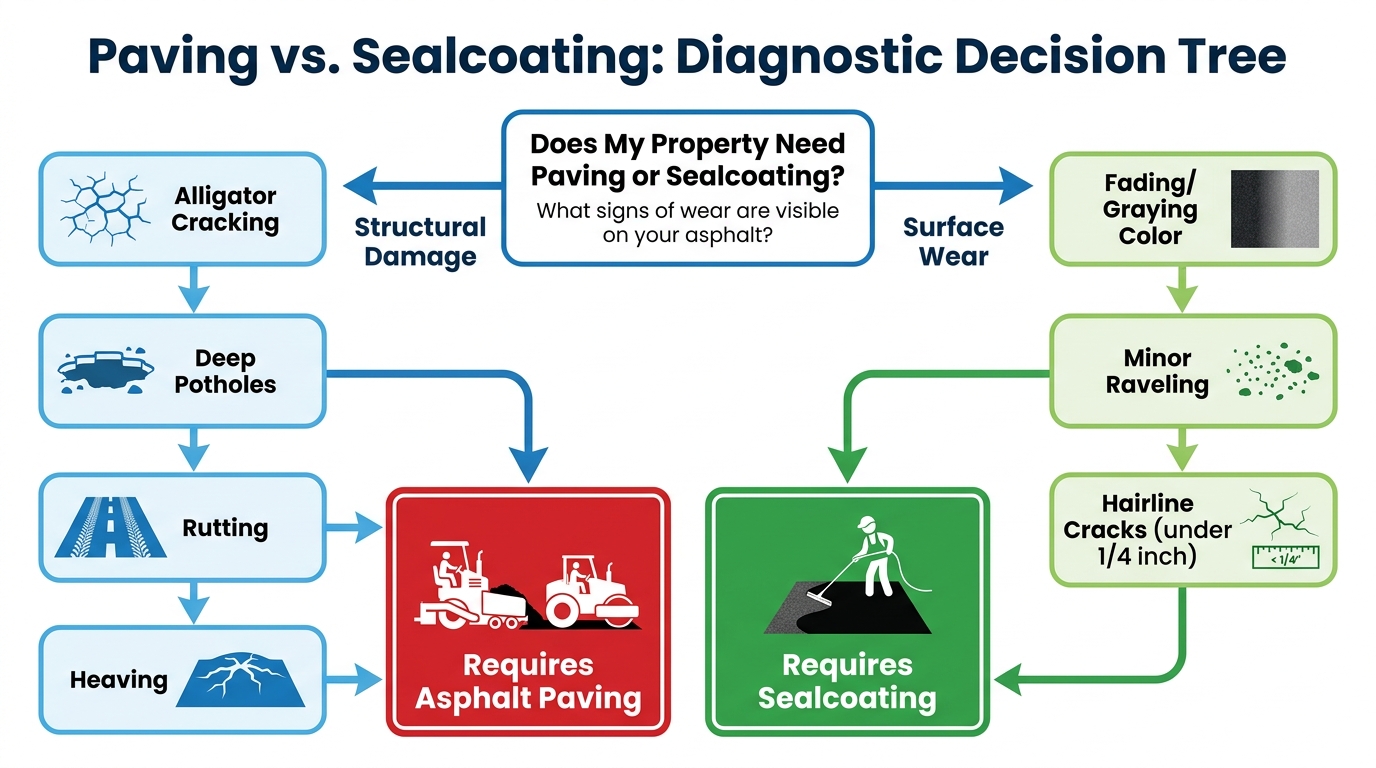
Understanding when your property has crossed the threshold from “maintainable” to “requires structural repair” can save you thousands of dollars and prevent safety hazards. Alligator Cracking (Fatigue Cracking) appears as interconnected cracks resembling reptile skin. This pattern indicates that the subbase has failed and the structural layer can no longer bear traffic loads. This type of distress signals that the pavement has reached the end of its functional life and requires immediate attention. Deep Potholes that extend down to the aggregate base layer allow water infiltration that systematically destroys the foundation. What starts as a small depression quickly becomes a major structural failure as water penetrates deeper with each rain or freeze-thaw cycle. Rutting manifests as surface depressions in the wheel paths caused by either base consolidation or improper asphalt mix design. These depressions collect water, accelerate deterioration, and create hazardous driving conditions. Heaving and Subsidence are particularly common in freeze-thaw climates where water infiltrates the base, freezes, expands, and literally destroys asphalt from below. Property owners in the Midwest and Pacific Northwest are especially familiar with this seasonal enemy of pavement longevity.
What Sealcoating Does (And Critically, What It Doesn’t Do)
Sealcoating is a liquid emulsion protective barrier applied to structurally sound asphalt. Historically, contractors used coal-tar based sealants, but the industry is rapidly shifting toward environmentally friendly asphalt emulsions due to concerns about Polycyclic Aromatic Hydrocarbons (PAHs) and their environmental impact.
The Science Behind Sealcoating Protection
Understanding how sealcoating protects your investment requires a brief look at what destroys asphalt in the first place. When exposed to ultraviolet rays, asphalt undergoes oxidation—the asphalt binder loses its flexibility and becomes brittle. This brittleness leads to cracking, which allows water intrusion, which accelerates deterioration exponentially. Sealcoating replenishes surface binders and creates a waterproof membrane that accomplishes several critical protective functions:
- It blocks UV penetration, preventing the oxidation process from accelerating
- It repels water, preventing the freeze-thaw damage that destroys asphalt from within
- It protects against petrochemical degradation from oil and gas spills that chemically break down asphalt binder
Signs Your Property Needs Sealcoating
Fading or Graying Surface indicates that your asphalt has lost its deep black color due to UV oxidation. This is the ideal time to apply sealcoating—before oxidation penetrates deep into the asphalt structure. Minor Surface Raveling occurs when small aggregate particles begin to dislodge from the surface. This early warning sign means the binder holding the aggregates together is weakening. Hairline Cracks less than 1/4-inch wide should be hot-rubber crack-filled before sealcoating. These cracks don’t indicate structural failure, but they do provide pathways for water intrusion if left untreated. Timeline-Based Maintenance dictates that newly paved asphalt should receive its first sealcoat 12-36 months after installation, then every 3-5 years thereafter, depending on traffic volume and climate conditions.
Critical Limitation: Zero Structural Benefit
Sealcoating provides absolutely zero structural benefit. It will not fill potholes, repair alligator cracking, or fix base failures. Applied to failing pavement, it simply washes away as broken asphalt shifts under vehicle weight. This is the single most important concept property owners must understand: sealcoating is preventative medicine, not emergency surgery.
Paving vs. Sealcoating: A Direct Comparison of Cost, Function, and Long-Term Value
Understanding the fundamental differences between these services requires examining them side-by-side across multiple dimensions.
| Feature | Asphalt Paving | Sealcoating |
|---|---|---|
| Primary Function | Restores structural integrity and load-bearing capacity | Protects surface from UV, water, and chemical damage |
| Material | Hot Mix Asphalt (HMA) at ~300°F | Liquid Asphalt Emulsion at ambient temperature |
| Cost Range | $2.50 – $6.00+ per sq. ft. (high capital expenditure) | $0.15 – $0.25 per sq. ft. (low-cost maintenance) |
| Lifespan/Frequency | Lasts 15-20+ years depending on traffic and subgrade | Must be reapplied every 3-5 years |
| Structural Benefit | Fixes potholes, alligator cracking, base failures | Zero structural benefit |
| Ideal Application | End-of-life pavement or severe subgrade failure | Structurally sound pavement showing early oxidation signs |
The Economics of Preventative Maintenance
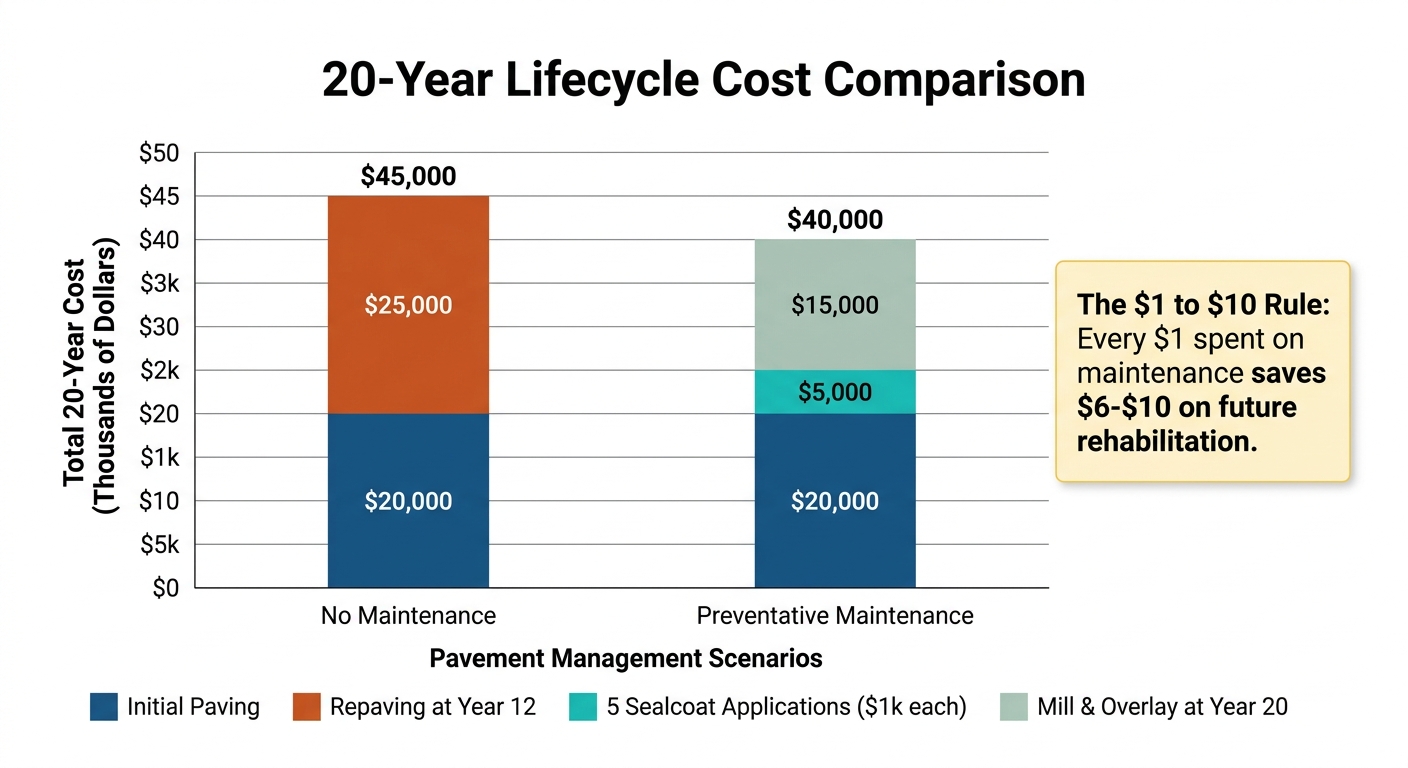
The financial implications of proper pavement management are staggering. Consider a 5,000 square foot parking lot: sealcoating costs approximately $750-$1,250, while repaving costs $12,500-$30,000. Proper maintenance timing is literally everything. The “1-to-10 Rule” demonstrates that every $1 spent on preventative maintenance saves $6-$10 in future rehabilitation costs. This isn’t marketing hype—it’s data compiled by the National Center for Pavement Preservation based on decades of pavement management research.
The Pavement Lifecycle Decision Tree
Understanding when to apply each service requires considering your pavement’s age and condition:
- New asphalt (0-2 years): Wait 12-18 months to allow the asphalt to cure fully, then apply the first sealcoat to lock in protection from the beginning.
- Maintained asphalt (3-15 years): Sealcoat every 3-5 years and crack seal annually. This regular attention keeps your pavement in the upper tier of serviceability, preventing the exponential deterioration that occurs once oxidation penetrates deeply.
- Aging asphalt (15-20 years): Monitor closely and plan for mill and overlay. Even well-maintained asphalt eventually reaches the end of its functional life as the binder loses elasticity and the structure becomes brittle.
- Failed asphalt (alligator cracking, potholes): Immediate paving required. Once structural failure begins, deterioration accelerates rapidly, and every month of delay increases the repair scope and cost.
Industry Market Context
The US asphalt paving market was valued at $29.1 billion in 2023, with commercial parking lot rehabilitation and residential paving driving significant growth as aging infrastructure requires updates. This massive market reflects the reality that virtually every commercial property and many residential properties will eventually need paving services—the only question is whether they’ll need it prematurely due to poor maintenance or at the natural end of a well-managed lifecycle.
The Financial Reality: How Preventative Maintenance Saves Thousands Over Your Pavement’s Lifetime
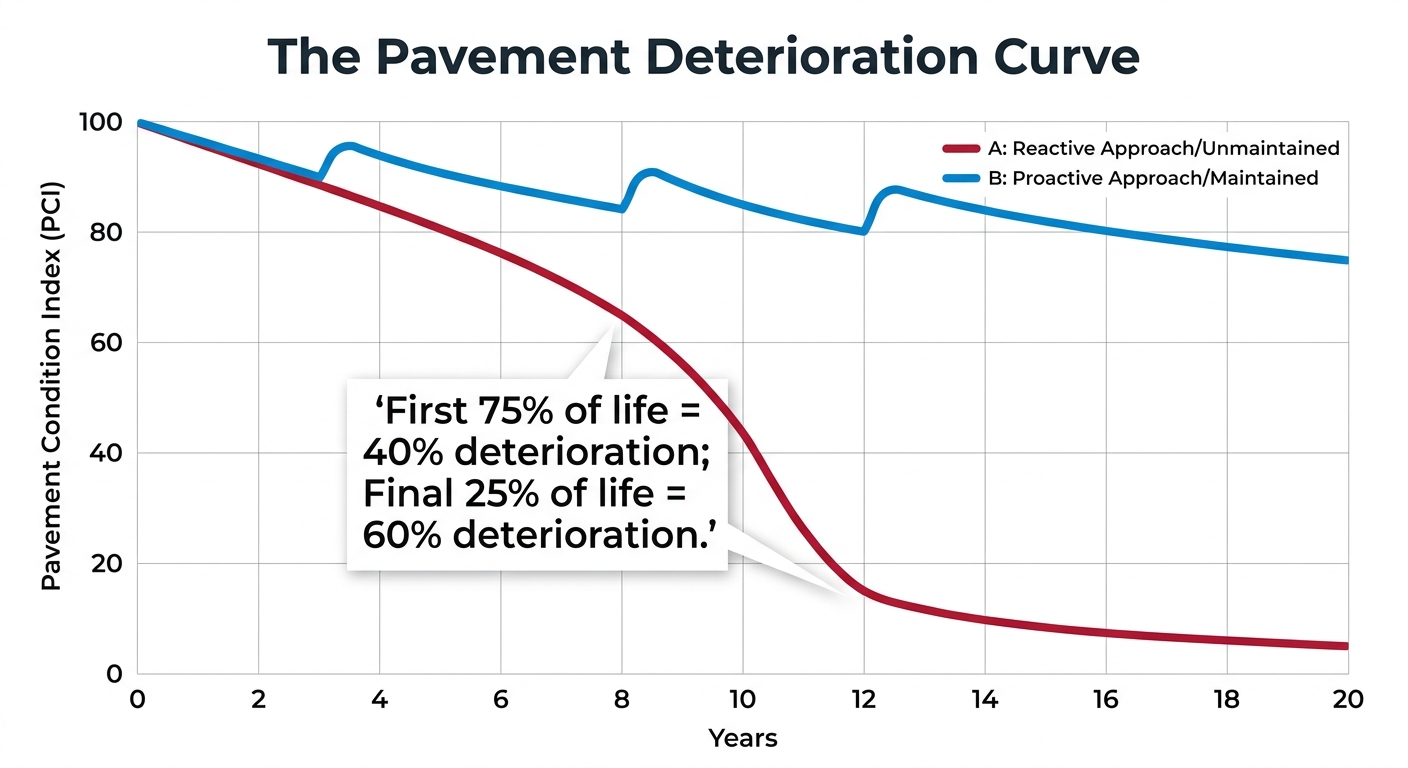
The most compelling argument for preventative maintenance comes from rigorous academic research that quantifies the financial impact of different pavement management strategies.
Case Study: National Center for Asphalt Technology Research
Researchers at Auburn University’s National Center for Asphalt Technology analyzed lifecycle costs of two identical asphalt pavements over 20 years, comparing reactive versus proactive management approaches. Pavement A (Reactive Approach) received zero maintenance until failure, requiring a full-depth mill and overlay at year 12. This represents the “fix it when it breaks” mentality many property owners adopt. Pavement B (Proactive Approach) received hot-rubber crack sealing and sealcoating at years 3, 7, and 12. This represents a systematic preventative maintenance program.
The Deterioration Curve: Understanding Non-Linear Failure
Asphalt pavement doesn’t deteriorate linearly—it follows an exponential decay curve that catches most property owners by surprise. During the first 75% of pavement life, only 40% of deterioration occurs. The pavement looks relatively good, and owners congratulate themselves on their “low-maintenance” investment. Then, during the final 25% of life, 60% of deterioration occurs. Suddenly, the pavement that looked “fine” last year is riddled with cracks, developing potholes, and requiring emergency repairs. The critical insight: Intervening early during the first 75% of life with sealcoating prevents entry into the rapid deterioration phase where repair costs skyrocket.
Real-World Financial Scenario
Let’s compare two 20-year management scenarios for the same parking lot: Scenario 1 (No Maintenance): $20,000 initial paving + $25,000 repaving at year 12 = $45,000 total over 20 years, with deteriorating pavement quality throughout. Scenario 2 (Preventative Maintenance): $20,000 initial paving + $1,000 sealcoating every 4 years (5 applications = $5,000) + $15,000 mill and overlay at year 20 = $40,000 total over 20 years, with superior pavement condition throughout. The preventative approach costs $5,000 less AND provides better pavement quality for the entire 20-year period. This is the financial reality that the Federal Highway Administration’s Pavement Preservation philosophy emphasizes.
The Pavement Preservation Approach
Modern pavement management has shifted from the historical “worst-first” approach (fixing only the most damaged roads) to the data-driven “Pavement Preservation” philosophy. This approach recognizes that preserving good pavements costs a fraction of reconstructing failed pavements. The FHWA advocates for systematic preventative maintenance because the data conclusively demonstrates superior long-term outcomes at lower lifecycle costs. For commercial property managers and homeowners, adopting this philosophy means viewing sealcoating not as an expense but as an investment with documented ROI.
The Costly Mistakes: Over-Sealing, Under-Paving, and Misdiagnosing Your Pavement’s Condition
Understanding what NOT to do is just as important as knowing the right course of action. These common mistakes cost property owners thousands of dollars annually.
Mistake #1: Over-Sealing Failing Pavement
The Problem: Property owners see deteriorating asphalt and assume a fresh sealcoat will “fix” the problem. They apply sealcoat to asphalt exhibiting alligator cracking or structural failure. Why It Fails: Sealcoat cannot bridge structural gaps. As the broken asphalt continues to shift under vehicle weight, the sealcoat simply flakes off like paint peeling from a damaged wall. The Consequence: You’ve wasted money on sealcoating AND you still need to pay for paving. Essentially, you’ve paid twice—once for an ineffective treatment and again for the correct solution. How to Avoid: Conduct an honest pavement assessment. If you see interconnected cracking patterns, potholes extending to the base layer, or significant rutting, call for a paving evaluation, not sealcoating. Smooth Rollin provides professional assessments that help property owners avoid this expensive mistake.
Mistake #2: Waiting Too Long to Sealcoat
The Problem: Property owners delay sealcoating until the asphalt is severely oxidized, deeply cracked, and actively raveling. Why It’s Costly: Once oxidation penetrates deep into the asphalt structure, sealcoating becomes ineffective. The damage has progressed beyond surface protection, and paving becomes necessary. The Consequence: What could have been an $800 sealcoating project becomes a $15,000 paving project because you waited too long to protect the investment. How to Avoid: Establish a regular 3-5 year sealcoating schedule starting 12-18 months after initial paving. Calendar reminders work well—treat it like changing your car’s oil rather than waiting until the engine seizes.
Mistake #3: DIY Diagnosis Without Professional Assessment
The Problem: Property owners attempt to self-diagnose complex pavement failures using internet research and visual inspection alone. The Risk: Misidentifying surface cracking (which sealcoating can address) versus structural cracking (which requires paving) leads to applying the wrong solution. The Solution: Professional pavement assessment can identify subgrade issues, drainage problems, and base failures that aren’t visible to untrained eyes. A qualified contractor examines not just surface appearance but also pavement deflection, drainage patterns, and traffic loading to recommend the appropriate intervention.
Mistake #4: Choosing Contractors Based Solely on Price
The Reality: Not all sealcoating or paving is equal in quality. The lowest bid often reflects corner-cutting that compromises longevity. Red Flags: Contractors offering prices significantly below market rates often:
- Apply excessively thin sealcoat applications (reducing protection duration)
- Skip critical surface preparation steps (reducing adhesion)
- Use inferior materials (reducing weather resistance)
The Long-Term Cost: Poor-quality work requires complete redo within 1-2 years instead of lasting the expected 3-5 years (sealcoating) or 15-20 years (paving). You’ve saved money upfront but spent more over the pavement’s lifecycle.
Environmental Considerations
The pavement maintenance industry is experiencing a significant environmental shift. Numerous municipalities and states have banned coal-tar sealants due to environmental and health concerns related to Polycyclic Aromatic Hydrocarbons (PAHs). Ensure your contractor uses environmentally responsible asphalt-based emulsions that provide equivalent protection without environmental contamination. Smooth Rollin stays current with environmental regulations and uses only approved materials that protect both your pavement and the environment.
Key Takeaways
Understanding the distinction between asphalt paving and sealcoating isn’t just technical knowledge—it’s financial protection for one of your property’s most significant investments.
The choice isn’t “paving or sealcoating”—it’s “paving when structurally necessary, sealcoating when preventatively appropriate.” Proper assessment, timely intervention, and working with qualified contractors who understand pavement science will protect your investment for decades. Your pavement is telling you what it needs through visual cues. Fading and minor cracking signal that sealcoating will provide cost-effective protection. Alligator cracking, potholes, and rutting announce that structural intervention is unavoidable. Learning to read these signals saves thousands of dollars and prevents the safety hazards associated with deteriorating pavement.
Ready to Protect Your Pavement Investment?
Get a professional pavement evaluation and customized maintenance strategy that protects your investment for the long term.
References:
- Federal Highway Administration (FHWA). (2023). Pavement Preservation Concepts and Techniques. U.S. Department of Transportation.
- Asphalt Institute. (2022). Pavement Distress Summary and Causes.
- United States Geological Survey (USGS). (2023). Coal-Tar-Based Pavement Sealcoat, Polycyclic Aromatic Hydrocarbons (PAHs), and Environmental Health.
- National Asphalt Pavement Association (NAPA). (2024). Economics of Asphalt Pavement.
- National Center for Pavement Preservation (NCPP). (2023). The Value of Pavement Preservation. Michigan State University.
- Transportation Research Board (TRB). (2021). National Cooperative Highway Research Program: Pavement Management Strategies. National Academies of Sciences, Engineering, and Medicine.
- IBISWorld. (2023). Asphalt Paving in the US – Market Size, Industry Analysis, Trends and Forecasts.
- National Center for Asphalt Technology (NCAT). (2022). Life Cycle Cost Analysis of Preventative Maintenance Treatments. Auburn University.