
Table of Contents
- The Triple Threat: How Portland & Vancouver’s Climate Accelerates Asphalt Deterioration
- Why the “Worst-First” Strategy Costs Property Managers $17,000+ More Over 15 Years
- Why $500 in Crack Sealing Prevents $5,000 in Pothole Repairs
- The UV Shield, Water Barrier, and Property Value Booster in One Application
- The Proven Preservation Schedule That Doubles Asphalt Lifespan
- Final Thoughts
Your parking lot isn’t just pavement—it’s a six-figure capital investment that either protects or drains your property’s value every single day. For commercial property owners and facility managers in Portland, Oregon, and Vancouver, Washington, the question isn’t if your asphalt will deteriorate—it’s when, and more importantly, how much it will cost you. Here’s the reality most property managers don’t realize: spending $1 on preventative maintenance today can save you $6 to $10 in future replacement costs. Yet despite this proven ROI, the majority of commercial properties in the Pacific Northwest operate on a “worst-first” maintenance strategy—ignoring cracks and minor damage until complete failure forces an expensive, disruptive repaving project. The Pacific Northwest’s unique climate—characterized by 36 to 42 inches of annual rainfall and intermittent freeze-thaw cycles—creates the perfect storm for accelerated pavement deterioration. UV oxidation during dry summers makes asphalt brittle, winter rains infiltrate cracks and erode the subgrade, and freezing temperatures expand trapped water by 9%, fracturing pavement from within. This article breaks down the science of asphalt preservation, provides a year-by-year maintenance roadmap specifically designed for PNW conditions, and demonstrates exactly how strategic crack sealing and sealcoating can extend your parking lot’s lifespan from 12-15 years to 20-25+ years.
The Triple Threat: How Portland & Vancouver’s Climate Accelerates Asphalt Deterioration
Understanding the region-specific environmental stressors is critical to implementing an effective preservation strategy. While many national resources provide generic asphalt maintenance advice, the Pacific Northwest presents unique challenges that demand a localized approach.
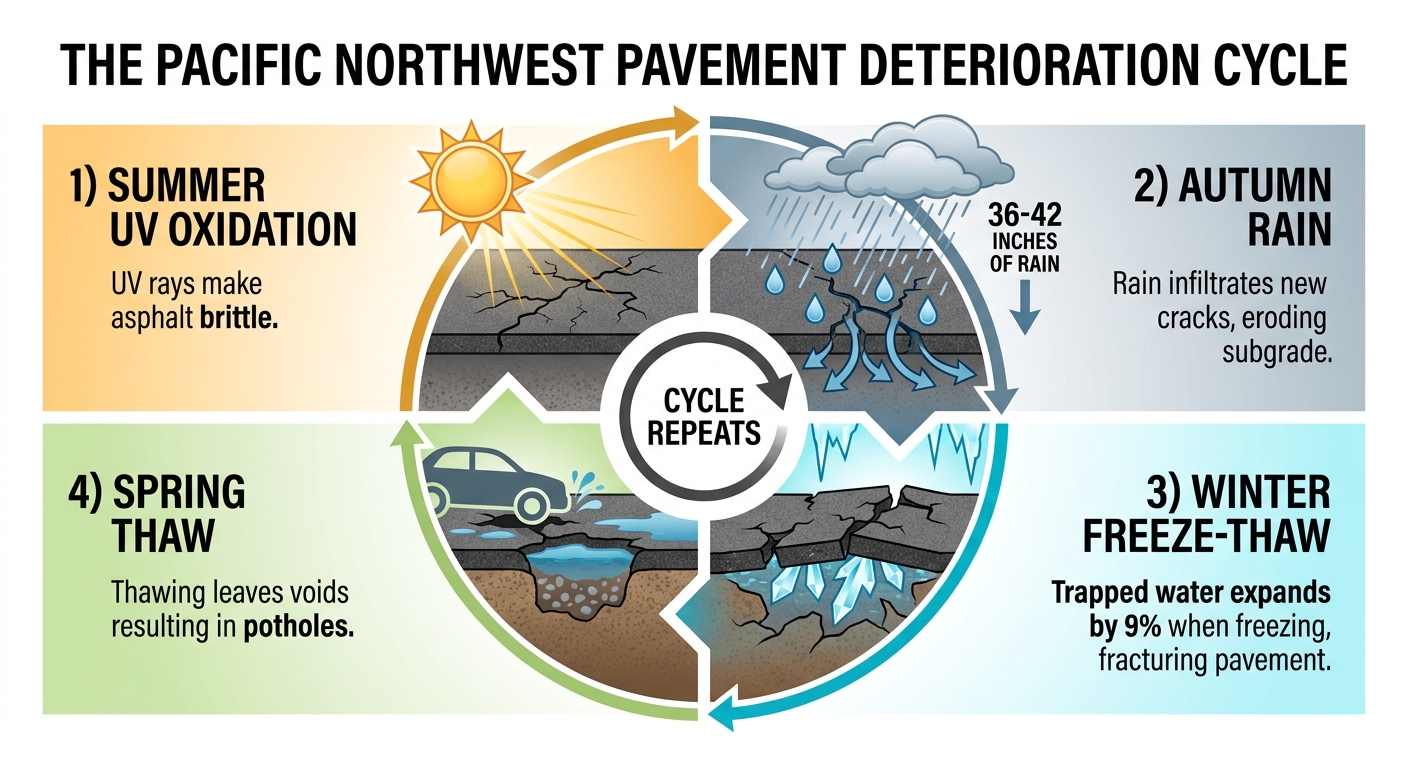
UV Oxidation During Dry Summers
The Pacific Northwest experiences surprisingly intense UV exposure during summer months. While the region is famous for its clouds and rain, those dry, sunny stretches from June through September deliver concentrated ultraviolet radiation that breaks down the asphalt binder (bitumen). This oxidation process causes the pavement surface to become brittle and lose the flexibility it needs to accommodate thermal expansion and contraction. As the binder deteriorates, microscopic surface cracks develop—creating the perfect entry points for water infiltration during the wet season.
Rainfall & Subgrade Erosion
Portland and Vancouver receive 36-42 inches of rain annually—significantly higher than the national average. When water infiltrates through oxidized, cracked asphalt, it doesn’t just sit on the surface. It travels downward, saturating and eroding the aggregate base layer and subgrade soil beneath. This subsurface erosion creates voids that lead to pavement settlement, cracking, and eventually, potholes. Unlike surface damage, subgrade erosion spreads laterally beneath seemingly healthy pavement, compromising structural integrity across increasingly larger areas.
Freeze-Thaw Damage: The Hidden Destroyer
While the PNW doesn’t experience the extreme cold of the Midwest, it does experience intermittent freeze-thaw cycles throughout winter. Water trapped in cracks expands by approximately 9% when it freezes. This expansion exerts tremendous pressure on the surrounding asphalt, widening existing cracks and creating new fractures. When temperatures rise and the ice melts, the pavement contracts, leaving larger voids that accelerate deterioration. Each freeze-thaw cycle compounds the damage exponentially.
Why the “Worst-First” Strategy Costs Property Managers $17,000+ More Over 15 Years
Most commercial properties operate on a reactive maintenance model, addressing pavement only after significant failure occurs. This section quantifies the financial impact of this approach and demonstrates why preventative maintenance isn’t just smart—it’s economically essential.
The Pavement Deterioration Curve
Research from the Federal Highway Administration demonstrates a critical principle: asphalt loses 40% of its quality in the first 75% of its lifespan. If left untreated during this period, it loses another 40% of its quality in just the next 12% of its life. This exponential deterioration curve means that once pavement crosses a critical threshold, costs skyrocket and options narrow dramatically.
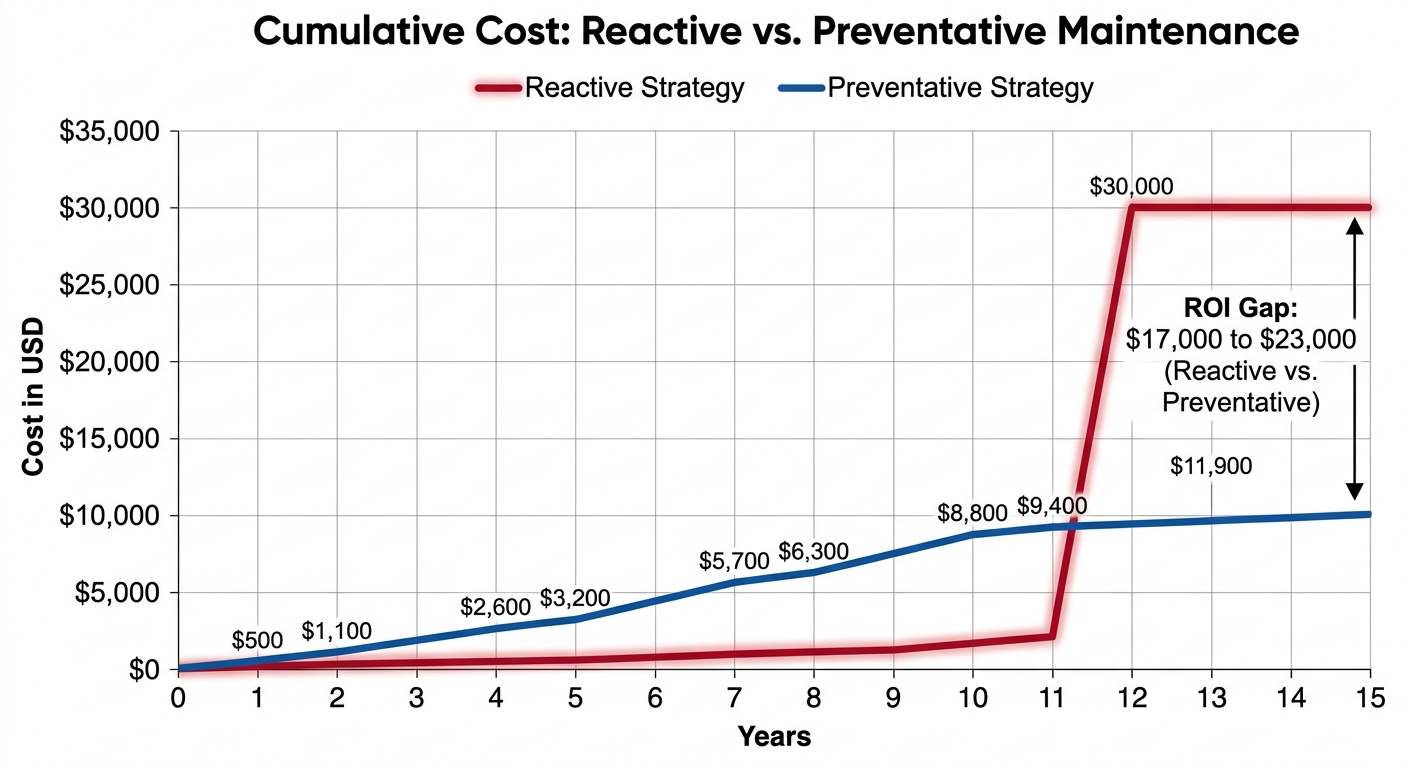
This visualization demonstrates the dramatic cost divergence between reactive and preventative approaches. Notice how the preventative strategy maintains relatively flat, predictable costs over the entire 20-year period, while the reactive approach shows minimal spending followed by a catastrophic spike around year 12-15 when total replacement becomes unavoidable.
Reactive Maintenance Cost Breakdown (15-Year Timeline)
- Years 1-8: Minimal intervention—property managers ignore hairline cracks and minor surface deterioration
- Years 9-11: Emergency pothole patching begins ($800-$1,500 per incident)
- Year 12: Complete structural failure necessitates full mill-and-overlay replacement ($2.50-$3.50 per square foot)
- Total estimated cost for 10,000 sq. ft. lot: $25,000 – $35,000
Preventative Maintenance Cost Breakdown (Same Timeline)
- Year 1-2: Initial sealcoating ($0.15-$0.25/sq. ft.)
- Years 3-15: Bi-annual crack sealing ($300-$600 per session) + sealcoating every 3-5 years
- Years 10-15: Minimal localized repairs
- Total estimated cost for 10,000 sq. ft. lot: $8,000 – $12,000
- Pavement lifespan extended to: 20-25+ years
Operational & Liability Considerations
Beyond direct costs, deteriorated parking lots create slip-and-fall hazards, ADA compliance issues, and negative first impressions for commercial tenants and customers. A study by the Building Owners and Managers Association International found that properties with well-maintained parking lots reported 5-7% higher perceived value among prospective tenants. For a commercial property valued at $2 million, that perception difference translates to $100,000-$140,000 in increased asset value—far exceeding the total cost of a preventative maintenance program.
Why $500 in Crack Sealing Prevents $5,000 in Pothole Repairs
Crack sealing is the single most cost-effective pavement preservation treatment available, yet it’s the most neglected by commercial property managers. Understanding the science behind this intervention explains why it delivers such exceptional ROI.
How Crack Sealing Works
Hot-pour rubberized crack sealant is applied to cleaned, routed cracks (typically 1/8 inch to 1/2 inch wide). The flexible, waterproof material bonds to the crack walls and prevents water infiltration while accommodating the natural expansion and contraction of asphalt during temperature fluctuations. Unlike cold-pour products available at hardware stores, professional-grade hot-pour sealants maintain their integrity through Pacific Northwest freeze-thaw cycles and provide multi-year protection.
Critical Timing Window
Cracks must be sealed when they first appear—before they widen beyond 1/2 inch and before water infiltration begins eroding the subgrade. Once subgrade erosion starts, the damage spreads laterally beneath the surface, compromising adjacent healthy pavement and requiring far more expensive repairs. A crack that could have been sealed for $2 per linear foot in year three can result in $2,500+ in section replacement costs by year eight.
Research-Backed Results: NCAT Test Track Study
The National Center for Asphalt Technology conducted controlled studies comparing pavement sections that received routine crack sealing versus control sections with no maintenance. The results were definitive:
- Sealed sections: Extended service life by 5-7 years
- Moisture infiltration reduction: Nearly 85% in sealed sections
- Pothole formation: Drastically reduced in maintained sections
These findings weren’t based on theoretical models—they came from real-world pavement subjected to heavy traffic loads under controlled conditions.
Optimal Frequency for PNW Climate
Given the region’s high rainfall and freeze-thaw exposure, crack sealing should be performed annually or bi-annually. Property managers should schedule inspections in late summer (after UV damage but before fall rains) and again in early spring (after winter freeze-thaw cycles). This dual-inspection approach catches deterioration at its earliest, most cost-effective stage.
The UV Shield, Water Barrier, and Property Value Booster in One Application
While many property managers view sealcoating as purely cosmetic, it serves critical protective and financial functions that justify its cost several times over.
Triple-Function Protection
- UV Barrier: Sealcoat contains coal tar or asphalt emulsion compounds that absorb UV radiation before it reaches the underlying pavement binder, slowing oxidation and brittleness
- Water Repellent: Creates a waterproof surface layer that sheds rainfall and prevents moisture penetration into the asphalt matrix
- Chemical Resistance: Protects against oil, gasoline, and de-icing chemical damage—common threats in commercial parking environments
The New Asphalt Curing Window
Newly installed asphalt must cure for 6-12 months before initial sealcoating. During this period, lighter oils in the asphalt binder evaporate and the pavement reaches optimal density. Applying sealcoat too early can trap these oils and prevent proper curing; applying it too late leaves the surface vulnerable to immediate UV and water damage. This 6-12 month window represents a critical inflection point where the first protective layer must be applied.
Strategic Reapplication Schedule
Research from the Asphalt Institute recommends sealcoating every 3-5 years for commercial properties. However, Pacific Northwest property managers should consider the more aggressive 3-year cycle due to higher moisture exposure. High-traffic areas such as loading zones and main drive lanes may require even more frequent treatment due to accelerated wear from vehicle traffic.
The Property Value Connection
The Building Owners and Managers Association study on commercial real estate found that properties with well-maintained parking lots (including fresh sealcoating and crisp striping) reported:
- 5-7% higher perceived property value among prospective tenants
- Improved tenant retention rates
- Reduced liability insurance claims related to parking lot incidents
This perception effect is particularly pronounced during tenant tours and property showings. A freshly sealcoated lot with clear, bright striping signals professional management and attention to detail—qualities that translate directly into lease negotiations and tenant satisfaction.
Application Best Practices for PNW Climate
- Timing: Apply during dry, warm weather (typically May-September in Portland/Vancouver)
- Temperature requirements: Minimum 50°F at application and 50°F overnight for proper curing
- Pre-treatment: Must be preceded by thorough crack sealing for maximum effectiveness
Attempting to sealcoat during cool, damp conditions results in poor curing, premature failure, and wasted investment. Pacific Northwest property managers must plan treatments during the narrow window of reliable summer weather.
The Proven Preservation Schedule That Doubles Asphalt Lifespan
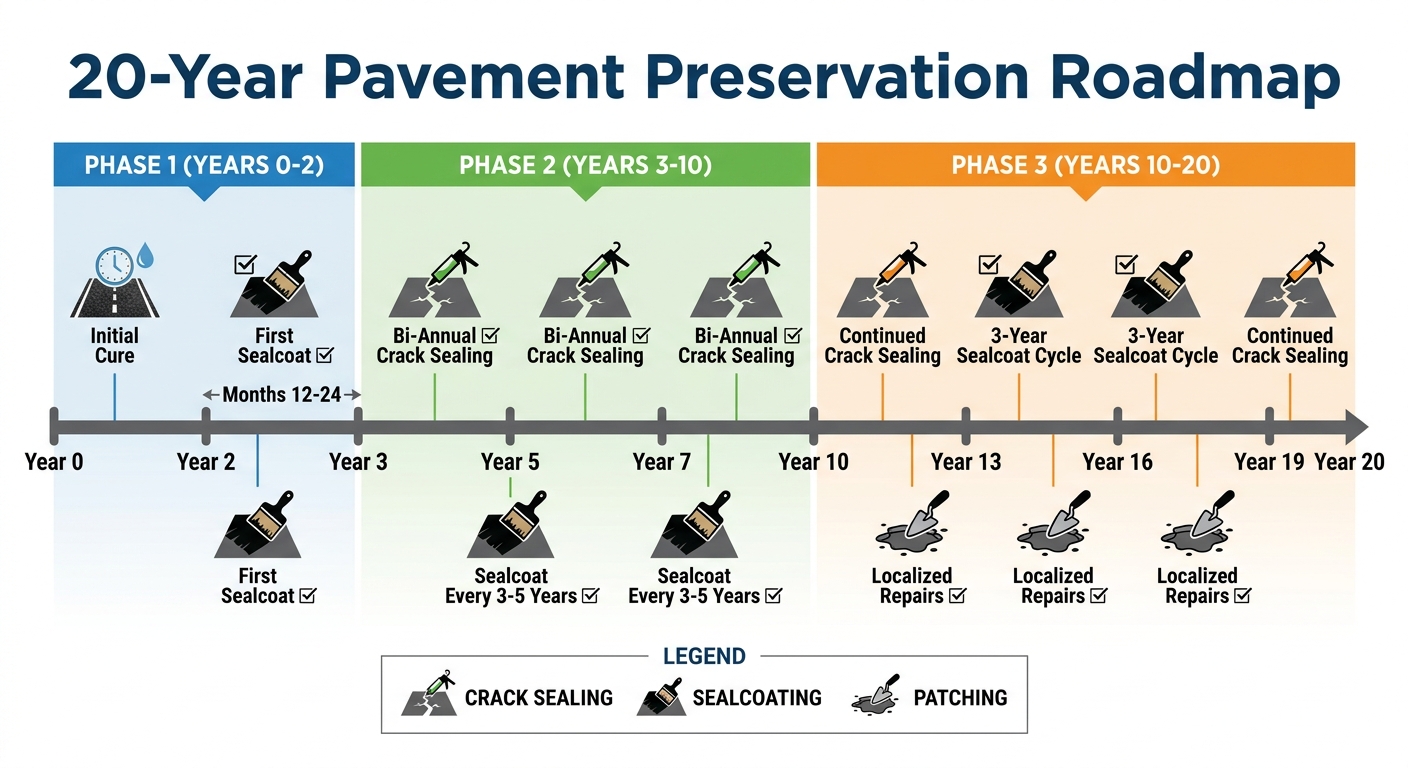
A concrete, actionable maintenance timeline specifically designed for commercial properties in Portland and Vancouver removes the guesswork from pavement management and ensures optimal intervention timing.
Phase 1: Initial Cure & First Defense (Years 0-2)
Month 0 (New Asphalt Installation):
- Allow asphalt to cure for minimum 6-12 months
- Perform initial surface cleaning and drainage inspection
- Document baseline condition with photos for future reference
Months 12-24 (First Critical Window):
- Action: Apply initial commercial-grade sealcoat
- Purpose: Establish first protective barrier against UV, water, and chemical damage before oxidation begins
- Striping: Refresh or install traffic striping and ADA-compliant parking designations
- Cost estimate: $1,500-$2,500 for 10,000 sq. ft.
This initial sealcoat application is non-negotiable. Skipping it leaves the pavement vulnerable during its most critical developmental phase when proper protection sets the trajectory for the entire lifecycle.
Phase 2: Routine Preservation (Years 3-10)
Annual or Bi-Annual Actions:
- Crack Sealing: Inspect entire lot in late summer and early spring; seal all cracks 1/8″ to 1/2″ wide with hot-pour rubberized sealant
- Drainage Maintenance: Clear catch basins, ensure proper water flow away from pavement
- Cost per session: $300-$600
Every 3-5 Years:
- Sealcoating: Reapply commercial sealcoat to refresh UV and water protection
- Striping Refresh: Repaint faded lines and markings
- Cost per application: $1,500-$2,500
As-Needed:
- Minor pothole patching: Address any localized failures immediately with infrared asphalt repair or cold-patch material
- Oil stain treatment: Clean petroleum spills promptly to prevent asphalt softening
During this phase, vigilance and consistency are key. Regular inspections catch problems at the crack stage before they evolve into potholes or structural failures.
Phase 3: Extended Lifespan Management (Years 10-20+)
- Continued Bi-Annual Crack Sealing: Maintain aggressive crack sealing schedule as pavement ages
- Sealcoating Every 3 Years: Increase frequency to 3-year cycle for optimal protection
- Localized Repairs: Budget for occasional section replacement in high-stress areas (loading zones, sharp turns)
- Strategic Mill & Overlay (Year 20+): Rather than complete reconstruction, well-maintained lots may only require a 1.5-2″ overlay to extend life another 15-20 years
Cost Comparison Summary
| Approach | Lifespan | Total Investment |
|---|---|---|
| Preventative Maintenance | 20-25 years | $8,000 – $12,000 |
| Reactive Maintenance | 12-15 years | $25,000 – $35,000 |
Implementation Tips for Property Managers
- Create a maintenance calendar: Schedule inspections and treatments during optimal weather windows
- Budget annually: Set aside 2-3% of lot replacement value each year for preservation
- Document everything: Photograph and record all maintenance activities for asset management records and future property sales
- Partner with specialists: Work with asphalt maintenance experts who understand PNW-specific climate challenges rather than general paving contractors
Property managers who implement this roadmap transform pavement management from reactive crisis response to predictable, budgetable asset preservation.
Final Thoughts
Your parking lot will deteriorate—that’s an unavoidable fact of physics and chemistry. But how quickly it fails and how much it costs you is entirely within your control. The data is unequivocal: property managers in Portland and Vancouver who implement strategic, preventative maintenance programs—centered on routine crack sealing, scheduled sealcoating, and proactive drainage management—reduce lifecycle costs by 60-70% while doubling pavement lifespan from 12-15 years to 20-25+ years. The Pacific Northwest’s unique climate demands a PNW-specific preservation strategy. Generic maintenance advice from national sources doesn’t account for our 40+ inches of annual rainfall, our UV-intense summers, or our intermittent freeze-thaw cycles. Success requires local expertise and climate-adapted schedules. The choice is simple: invest $1 in preservation today, or pay $6-$10 in replacement costs tomorrow. For commercial property owners who view their parking lot as a capital asset rather than an inevitable expense, partnering with specialized asphalt maintenance experts transforms pavement from a depreciating liability into a preserved, value-generating investment.
Ready to Protect Your Investment?
Implement a science-backed preservation strategy for your Portland or Vancouver commercial property today.
References:
- Pavement Preservation & Recycling Alliance (PPRA). (2024). The Economics of Pavement Preservation: Cost Calculators. Retrieved from https://roadresource.org/preservation
- National Weather Service. (2024). Portland Climate Data and Precipitation Averages. Retrieved from https://www.weather.gov/pqr/portlandclimate
- Federal Highway Administration (FHWA). (n.d.). Pavement Preservation Concepts and Guidelines. U.S. Department of Transportation. Retrieved from https://www.fhwa.dot.gov/pavement/preservation/
- Asphalt Institute. (2023). Maintenance and Rehabilitation of Asphalt Pavements. Retrieved from https://www.asphaltinstitute.org/engineering/maintenance-and-rehabilitation/
- Building Owners and Managers Association (BOMA) International. (2021). The Value of Curb Appeal in Commercial Real Estate. Retrieved from https://www.boma.org/BOMA/Research-Resources/3-BOMA-Spaces/News/The_Value_of_Curb_Appeal.aspx
- Federal Highway Administration (FHWA). (1999). Materials and Procedures for Sealing and Filling Cracks in Asphalt-Surfaced Pavements. (Publication No. FHWA-RD-99-147). Retrieved from https://www.fhwa.dot.gov/publications/research/infrastructure/pavements/99147/99147.pdf
- National Center for Asphalt Technology (NCAT) at Auburn University. (2022). Test Track Research and Pavement Life Extension Studies. Retrieved from https://eng.auburn.edu/research/centers/ncat/