
Table of Contents
For commercial property managers, parking lots often represent overlooked risk zones rather than critical business assets. That hairline crack weaving across your pavement? It’s not just an aesthetic flaw—it’s a ticking time bomb that can spiral into catastrophic structural failure, costly legal battles, and significant safety hazards. Recent data reveals a sobering reality: falls account for over 8 million hospital emergency room visits annually in the United States, with many occurring on poorly maintained commercial surfaces. Meanwhile, pothole damage costs U.S. drivers approximately $3 billion each year, with average repair costs reaching $600 per incident. The hidden truth is that what begins as a seemingly minor surface defect can rapidly deteriorate under environmental stress and vehicular loads. Water infiltration, freeze-thaw cycles, and oxidation transform small cracks into dangerous potholes—exposing property owners to premises liability lawsuits, ADA compliance violations, and exponentially higher repair costs. This comprehensive guide explores the mechanical progression of pavement failure, the legal and financial dangers of deferred maintenance, and why proactive crack sealing delivers a proven $6-$10 return for every $1 invested. Understanding these risks isn’t just about pavement—it’s about protecting your property, your tenants, and your bottom line.
How a Hairline Crack Becomes a Dangerous Pothole
Understanding the mechanical lifecycle of asphalt deterioration reveals why early intervention is critical for preventing structural collapse. Asphalt pavement consists of a flexible composite material made from aggregates—crushed rock, sand, and gravel—bound together by asphalt cement (bitumen). Despite its initial durability, this material remains highly vulnerable to environmental degradation through a predictable four-stage process.
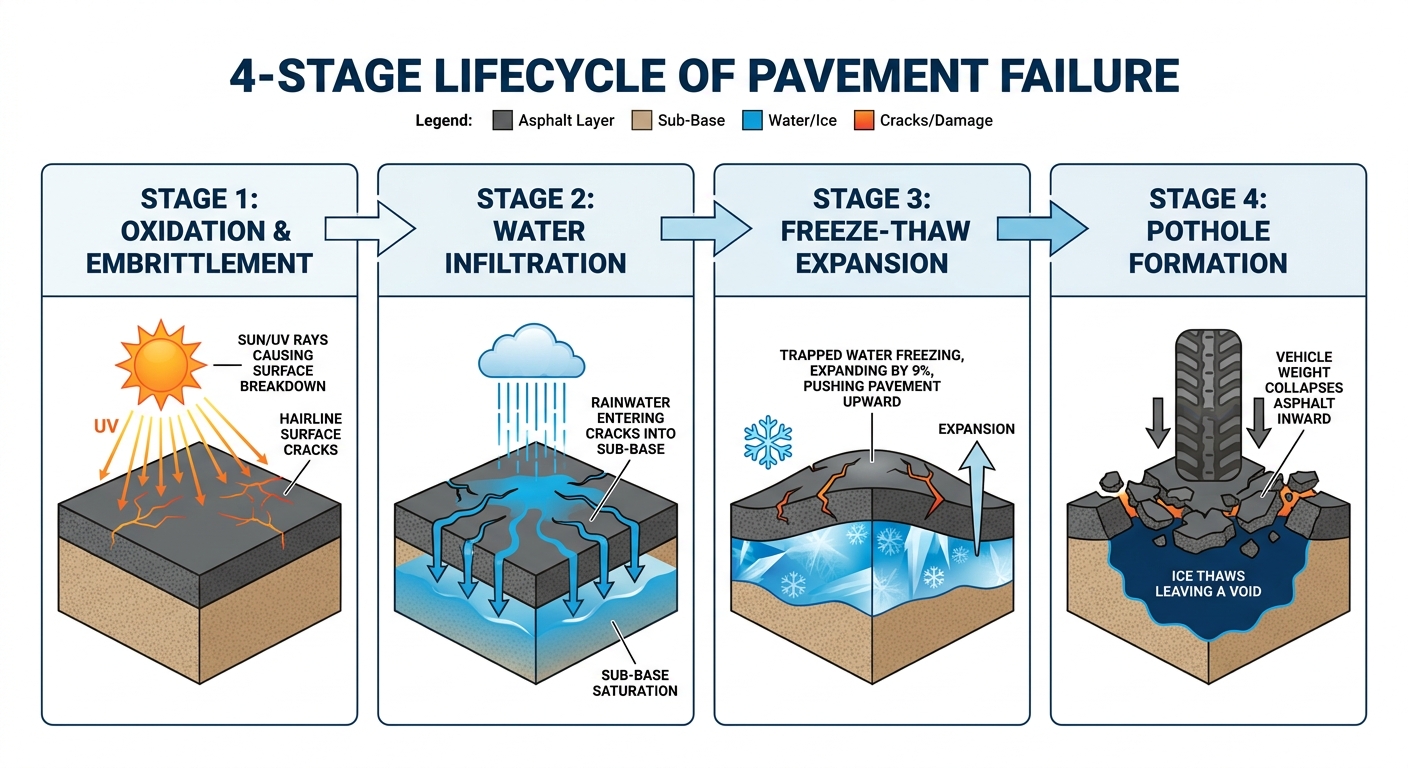
The deterioration process begins with oxidation and embrittlement. UV exposure and oxygen cause the asphalt binder to harden and lose flexibility, making it prone to surface cracking under traffic loads. What starts as microscopic surface wear becomes visible fractures as the pavement loses its ability to flex with temperature changes and vehicle weight. Once cracks appear, water infiltration becomes the critical threat. These cracks act as conduits for surface water to penetrate sub-base layers. The Federal Highway Administration identifies moisture intrusion as the primary catalyst for structural pavement failure. Even a crack measuring just 1/4 inch can channel thousands of gallons of water into the pavement foundation over a single season. In cold climates, the third stage—freeze-thaw expansion—accelerates destruction dramatically. Trapped water freezes and expands by approximately 9%, forcing pavement upward and creating voids beneath the surface when it thaws. Climate change is increasing the frequency of temperature fluctuations and extreme precipitation events across North America, dramatically accelerating freeze-thaw cycles and pothole formation rates. The final stage is pothole formation. When vehicles drive over unsupported asphalt above these voids, the pavement collapses inward, creating dangerous potholes. What might start as a 1/4-inch crack can become a 12-inch pothole within a single winter season if left unaddressed. This progression isn’t gradual—it’s exponential, with deterioration rates compounding as structural integrity diminishes.
When Neglected Pavement Becomes a Legal Liability
Property managers face severe legal and financial consequences under premises liability law when preventable pavement hazards cause injuries or property damage. The legal doctrine of premises liability establishes that property owners have a duty of care to maintain safe environments for invitees and licensees. Failing to address visible pavement defects creates compelling evidence of negligence in litigation.
Trip-and-Fall Litigation Exposure
Falls represent the leading cause of emergency room visits at 21.3%, with over 8 million hospital visits annually. For commercial properties, the financial impact is staggering. Average slip-and-fall claim costs exceed $50,000, including legal defense and settlements, with commercial property owners bearing full liability when negligence is proven. The critical factor in these cases is documentation. Visible, unrepaired potholes and cracks establish a clear record of negligence, significantly strengthening plaintiff cases. Property managers who ignore obvious hazards face the dual burden of not only compensating injured parties but also defending against accusations of willful disregard for safety.
Americans with Disabilities Act (ADA) Violations
ADA guidelines mandate accessible routes on commercial properties with strict surface standards. Surface level changes greater than 1/4 inch must be beveled, while changes exceeding 1/2 inch require ramp installation. Unpatched potholes creating vertical deviations routinely violate these standards, exposing properties to federal lawsuits and substantial compliance fines. The compounding risk is particularly severe: ADA violations often accompany trip-and-fall claims, creating multiple liability exposures from a single unrepaired defect. A property manager facing both a personal injury lawsuit and an ADA compliance action can see legal costs multiply far beyond the original incident.
Vehicle Damage Claims
Beyond pedestrian safety, potholes cause significant vehicular damage including blown tires, bent wheels, and suspension failures. AAA reports pothole damage costs U.S. drivers roughly $3 billion annually, averaging $600 per repair incident. Commercial properties with private parking lots can be held liable for vehicle damages when owners failed to address known hazards promptly.
Insurance Implications
Multiple claims can drive up commercial property insurance premiums or result in coverage denials. Some insurers now conduct regular parking lot inspections and require documented maintenance programs as conditions for coverage.
The stark reality: a single severe trip-and-fall incident on an unrepaired pothole can cost more than 10 years of proactive crack sealing maintenance. The question isn’t whether you can afford preventative maintenance—it’s whether you can afford not to invest in it.
Proactive Maintenance Delivers a 6:1 to 10:1 Return on Investment
Industry research definitively proves that preventative crack sealing is exponentially more cost-effective than reactive pothole patching and full pavement replacement. The distinction between maintenance strategies fundamentally determines both lifecycle costs and liability exposure. Proactive (preventative) maintenance involves cleaning early-stage cracks and applying hot-pour rubberized sealant to prevent water penetration into sub-base layers. This intervention addresses defects while they’re still manageable, before structural compromise occurs. Reactive (corrective) repair requires cutting out failed asphalt sections, re-compacting damaged base materials, and filling voids with new hot mix asphalt—a far more expensive and disruptive process that typically occurs after significant structural damage has already happened.
The National Center for Pavement Preservation’s Landmark Finding
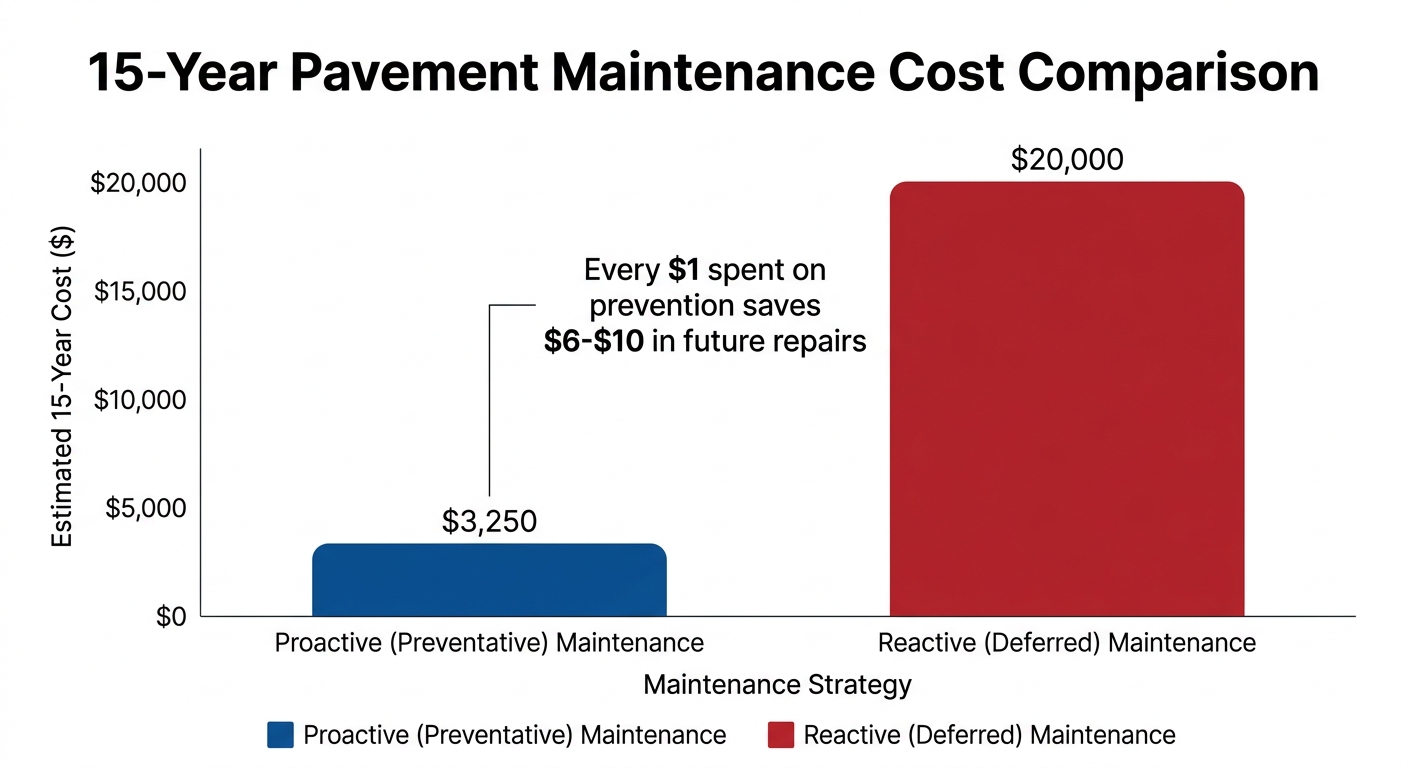
The NCPP’s comprehensive research establishes that every $1 spent on preventative maintenance saves $6 to $10 in future rehabilitation and replacement costs. This ROI calculation accounts for material costs, labor, equipment, and avoided structural deterioration. The research represents decades of pavement management data across thousands of commercial properties.
15-Year Lifecycle Cost Analysis
Based on a standard 10,000 square foot commercial parking lot, the financial contrast between strategies is dramatic:
| Maintenance Strategy | Total Lifecycle Cost | Liability Risk |
|---|---|---|
| Proactive (Preventative) Routine crack sealing every 2-3 years plus sealcoating |
$2,500 – $4,000 | Low (hazards eliminated early) |
| Reactive (Deferred) Ignoring cracks; emergency pothole patching; full mill and overlay at Year 12 |
$15,000 – $25,000 | High (prolonged exposure to litigation) |
The cost differential extends well beyond materials and labor:
- Business disruption: Emergency pothole repairs often require closing parking sections during business hours, impacting customer access and tenant satisfaction
- Reputation damage: Deteriorated pavement creates negative first impressions that affect lease renewals and property values
- Accelerated deterioration: Each unrepaired crack allows exponentially more water infiltration, compounding damage rates
- Liability exposure window: The period during which hazards remain unaddressed creates statistical probability of injury incidents that grows with each passing day
Strategic property managers increasingly view crack sealing as “preventative insurance” rather than discretionary maintenance. This fundamental shift in budget prioritization transforms pavement management from a reactive expense into a proactive investment that protects property value, reduces risk, and delivers measurable returns.
How Strategic Crack Sealing Extended Pavement Life by 67%
University-backed research demonstrates how systematic preventative maintenance programs deliver dramatic lifecycle extensions and eliminate liability claims. A comprehensive case study evaluated by university local roads programs provides compelling evidence for the transformative power of proactive pavement management.
Case Study Overview
A commercial retail center serving high-traffic retail tenants in a northern climate with severe freeze-thaw cycles implemented a strict pavement management system for its 45,000 square foot parking lot. The property faced the typical challenges of northern climates: harsh winters, dramatic temperature swings, and heavy precipitation that accelerated traditional pavement deterioration.
Intervention Strategy
Rather than waiting for visible potholes to appear, property management implemented a predictive maintenance approach with three key components:
- Proactive crack sealing timing: Routing and sealing of all cracks measuring 1/8 inch to 1 inch before winter weather arrival. This proactive timing prevented water infiltration during the most damaging freeze-thaw period.
- Annual condition assessments: Systematic pavement inspections using measurement protocols rather than casual visual observation, ensuring consistent data collection.
- Predictive maintenance scheduling: Data-driven approach based on crack density measurements rather than reactive emergency repairs, allowing budget forecasting and preventing deferred maintenance.
Documented Results
The outcomes exceeded even optimistic projections:
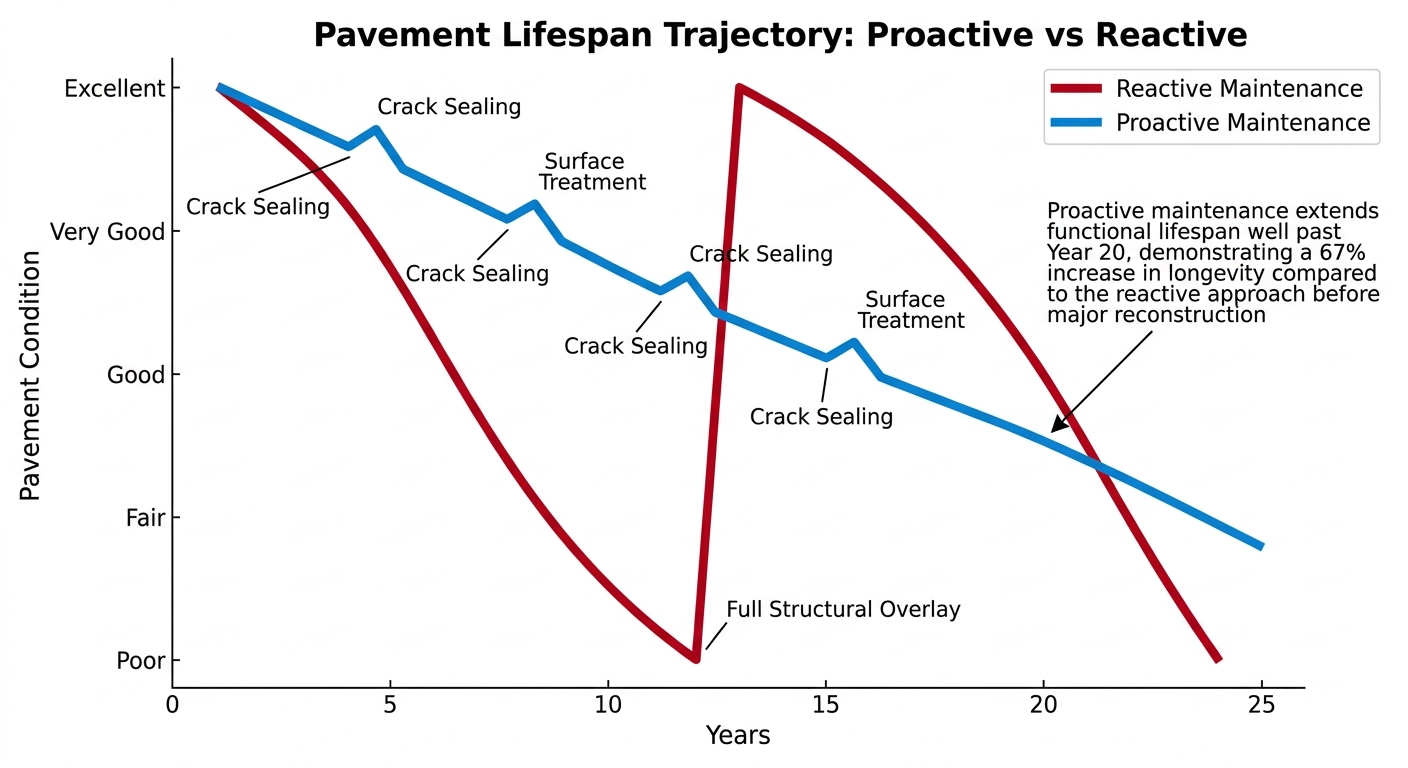
- 67% lifecycle extension: Original pavement projected to require full structural overlay at 12 years extended to over 20 years with systematic crack sealing
- Lower total investment: Total maintenance investment over 20 years was less than the cost of a single full reconstruction
- Zero liability claims: Zero trip-and-fall claims filed against property management over the 10-year study period
- Zero vehicle damage reports: No vehicle damage reports related to pavement defects recorded
- 15% insurance reduction: Commercial insurance premiums decreased due to the claims-free record, creating ongoing financial benefits beyond the pavement itself
- Tenant satisfaction: Parking lot condition cited as a “significant positive factor” in lease renewals, becoming a competitive differentiator in a crowded retail real estate market
Critical Takeaway
The retail center’s approach transformed pavement maintenance from a reactive expense into a strategic asset management program, delivering compound benefits across financial performance, risk mitigation, and property value preservation. The case demonstrates that systematic preventative maintenance isn’t just cost-effective—it’s a competitive business advantage that impacts every aspect of property operations.
Five Essential Steps to Protect Your Property Investment
Property managers can immediately reduce liability exposure and maximize pavement longevity by implementing these evidence-based maintenance protocols. The transition from reactive to proactive management requires systematic processes, but the implementation is straightforward and delivers immediate risk reduction.
Step 1: Conduct Comprehensive Pavement Assessment
Schedule a professional inspection to document all existing cracks, surface deterioration, and drainage issues. Photograph and map defects to establish baseline condition and track progression over time. This documentation serves dual purposes: identifying maintenance priorities and creating legal protection by demonstrating duty of care. Timing matters significantly: Conduct assessments in spring after winter damage becomes visible but before summer heat exacerbates deterioration. Spring inspections allow repairs before the next winter cycle while materials and contractors are readily available.
Step 2: Prioritize Repairs by Risk Level
Not all defects require immediate attention, but some create urgent liability exposure:
- Immediate priority: Seal all cracks wider than 1/4 inch and any defects creating trip hazards or ADA violations. These represent active safety hazards with immediate legal exposure.
- Secondary priority: Address smaller cracks measuring 1/8 inch to 1/4 inch before winter weather arrives. While not immediate hazards, these defects will rapidly deteriorate without intervention.
- Long-term planning: Schedule sealcoating for pavement showing surface oxidation but minimal cracking, addressing deterioration before structural damage occurs.
Step 3: Establish Preventative Maintenance Schedule
Implement routine crack sealing every 2-3 years regardless of visible deterioration. This predictable schedule prevents the reactive crisis management that characterizes deferred maintenance programs. Plan sealcoating applications every 3-5 years to protect against oxidation and UV damage. Budget for periodic assessments to identify emerging issues before they become emergencies. Treating pavement management as ongoing asset protection rather than episodic repair fundamentally changes cost trajectories and eliminates the budget shocks of emergency reconstruction.
Step 4: Document Everything
Maintain detailed maintenance records including dates, services performed, and contractor documentation. Comprehensive maintenance records demonstrate proactive duty of care, significantly strengthening defense against premises liability claims. Documentation transforms from administrative burden to legal protection. Photograph repaired areas to document condition improvements. Visual records prove maintenance investments and demonstrate the property’s commitment to safety standards. These records become invaluable if claims arise years after repairs.
Step 5: Partner with Qualified Professionals
Select contractors with proven experience in commercial property maintenance. Verify proper licensing, insurance coverage, and material certifications before engaging services. Quality matters profoundly—substandard crack sealing using improper materials can fail within months, negating the investment and creating false confidence in protection. Look for contractors who understand pavement management systems rather than just repair techniques. The best partners provide assessment services, maintenance planning, and documentation support rather than simply executing work orders.
Investment Reality Check
Most commercial properties can implement comprehensive preventative maintenance programs for less than $0.25 per square foot annually—a fraction of reactive repair costs or a single liability claim. This investment protects assets worth hundreds of thousands or millions of dollars while eliminating risks that can destroy property values overnight.
Key Takeaways
The evidence is unambiguous: ignoring asphalt cracks and potholes is not merely a maintenance oversight—it’s a strategic failure with cascading financial, legal, and safety consequences. What property managers perceive as “minor cosmetic flaws” are actually structural emergencies in early stages, with the power to generate liability claims exceeding $50,000, trigger ADA compliance violations, and necessitate premature pavement replacements costing 6-10 times more than preventative maintenance. The National Center for Pavement Preservation’s research definitively establishes that every dollar invested in crack sealing returns $6 to $10 in avoided future costs. Combined with documented case studies showing 67% lifecycle extensions and complete elimination of injury claims, the strategic value of proactive maintenance is irrefutable. For commercial property managers, the question isn’t whether to invest in pavement maintenance—it’s whether you can afford not to. Every day of deferred maintenance compounds structural deterioration, increases liability exposure, and erodes property value.
Protect Your Property Investment Today
Ready to eliminate hidden liabilities and extend your pavement life? Smooth Rollin specializes in professional crack sealing and asphalt patching that extends pavement life, ensures ADA compliance, and delivers measurable ROI.
References
- Federal Highway Administration (FHWA). (2023). Pavement Preservation. U.S. Department of Transportation. https://www.fhwa.dot.gov/pavement/preservation/
- Environmental Protection Agency (EPA). (2023). Climate Change Indicators: Weather and Climate. https://www.epa.gov/climate-indicators/weather-climate
- National Floor Safety Institute (NFSI). (2024). Slip & Fall Quick Facts. https://nfsi.org/nfsi-research/quick-facts/
- U.S. Department of Justice. (2010). Americans with Disabilities Act (ADA) Standards for Accessible Design: Chapter 3 (Floor and Ground Surfaces). ADA.gov. https://www.ada.gov/law-and-coord/ada-design-standards/
- American Automobile Association (AAA). (2022). Pothole Damage Costs Drivers Billions. AAA Newsroom. https://newsroom.aaa.com/2022/03/pothole-damage-costs-drivers-billions/
- National Center for Pavement Preservation (NCPP). (2022). Pavement Preservation Concepts and Economics. Michigan State University. https://www.pavementpreservation.org/
- Cornell Local Roads Program. (2023). Pavement Maintenance Basics. Cornell University College of Agriculture and Life Sciences. https://cals.cornell.edu/nys-local-roads-program